



About the Author
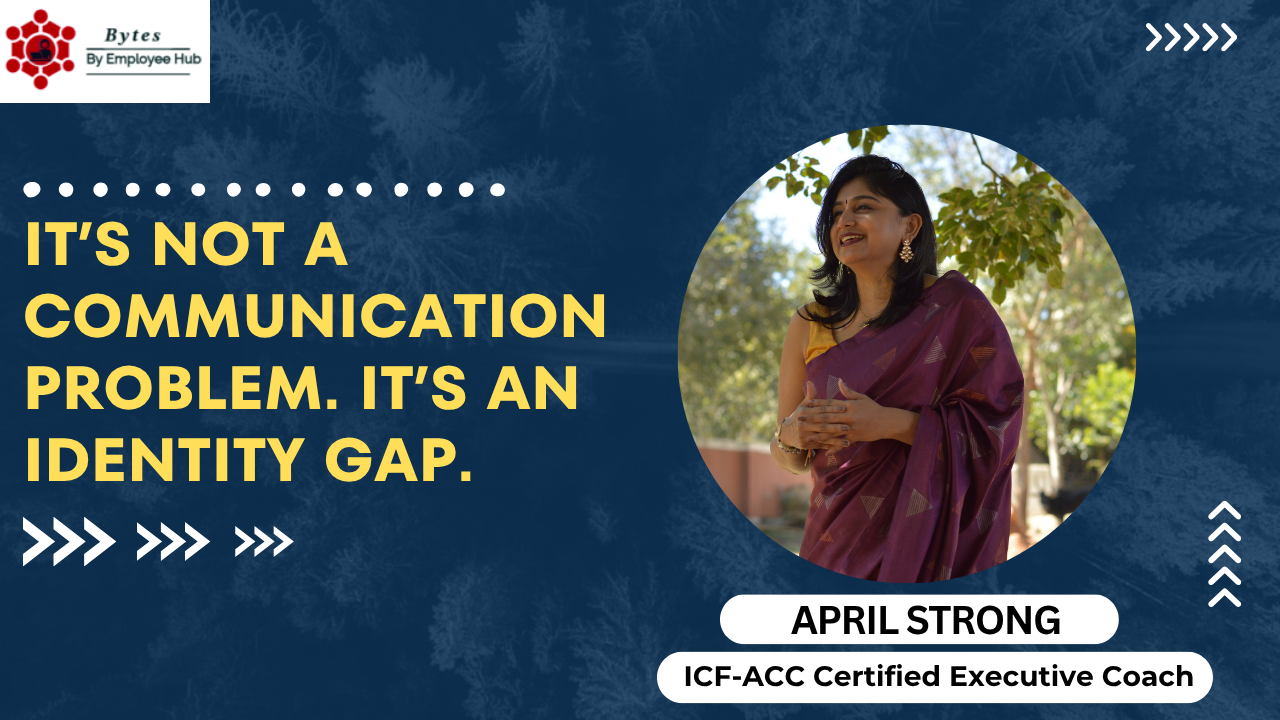
April Strong is a Corporate Trainer and ICF-ACC Certified Executive Coach who works with senior leaders, founders, and high-performing professionals across global organizations. She helps individuals become clear, credible, and impossible to ignore in high-stakes moments by focusing on identity-driven communication and leadership presence
It’s Not a Communication Problem. It’s an Identity Gap.
In most organizations today, communication is treated like a skill gap.
So we send people to workshops.
We train them on frameworks.
We teach them how to speak, present, and influence.
And yet the same people still hesitate in the moments that matter most.
Not because they don’t know what to say.
But because something deeper holds them back.
The real problem isn’t Communication
After working with senior leaders, founders, and high-performing professionals across global organizations, one pattern becomes impossible to ignore:
It’s not a communication problem.
It’s an identity gap.
You can have the best ideas in the room, but if you don’t see yourself as someone whose voice carries weight, you will dilute, delay, or completely withhold your message.
That hesitation doesn’t come from lack of skill.
It comes from misalignment between:
- Who you are
- Who you believe you are allowed to be
Where It Shows Up in the Workplace
This gap is subtle but costly.
It shows up when:
- A capable leader softens their stance in high-stakes meetings
- A founder avoids visibility despite having a strong vision
- A high-potential professional overthinks instead of speaking up
- Difficult conversations are delayed until they become bigger problems
From an HR and leadership perspective, this isn’t just a communication issue.
It directly impacts:
- decision-making speed
- leadership presence
- team trust
- and organizational culture
Because how people show up in one conversation is how they show up everywhere.
Why Traditional Communication Training falls short
Most communication training focuses on:
- Structure
- Articulation
- Delivery
All important but incomplete.
Because even after learning all of this, people still ask:
“Why do I still hold back when it matters most?”
The answer is simple:
You cannot outperform the identity you are operating from.
If someone internally sees themselves as:
- “Not authoritative enough”
- “Not ready yet”
- “Not the kind of person who speaks up”
No amount of technique will sustain change.
At best, it creates temporary improvement.
At worst, it creates performance without authenticity.
The Shift: From Skill-Building to Identity Expansion
Real transformation happens when we move from:
- Hesitation → Clarity
- Overthinking → Confidence & Courage
- Knowing → Expressing
- Presence → True Influence
This is not about becoming someone else.
It’s about removing the internal resistance that prevents people from fully showing up as who they already are.
When that shift happens:
- Leaders speak with conviction without over-explaining
- Professionals navigate difficult conversations with calm authority
- Individuals stop waiting for permission and start creating impact
And most importantly, they stop holding themselves back.
What this means for Organizations
If organizations want stronger leaders, better collaboration, and faster execution, the focus cannot be only on what people say.
It has to include:
- How they see themselves
- How safe they feel to express
- and How consistently they show up under pressure
Because communication is not just a skill.
It is a reflection of identity, environment, and internal alignment.

And when that alignment is built, communication becomes effortless, not forced.
In every organization, there are people who are: brilliant, capable, and full of potential, but not fully leveraged.
Not because they lack skill.
But because they haven’t stepped into the version of themselves
that can carry their ideas with clarity and conviction.
The real work is not just teaching people how to communicate.
It is helping them become the kind of person who no longer holds back.