





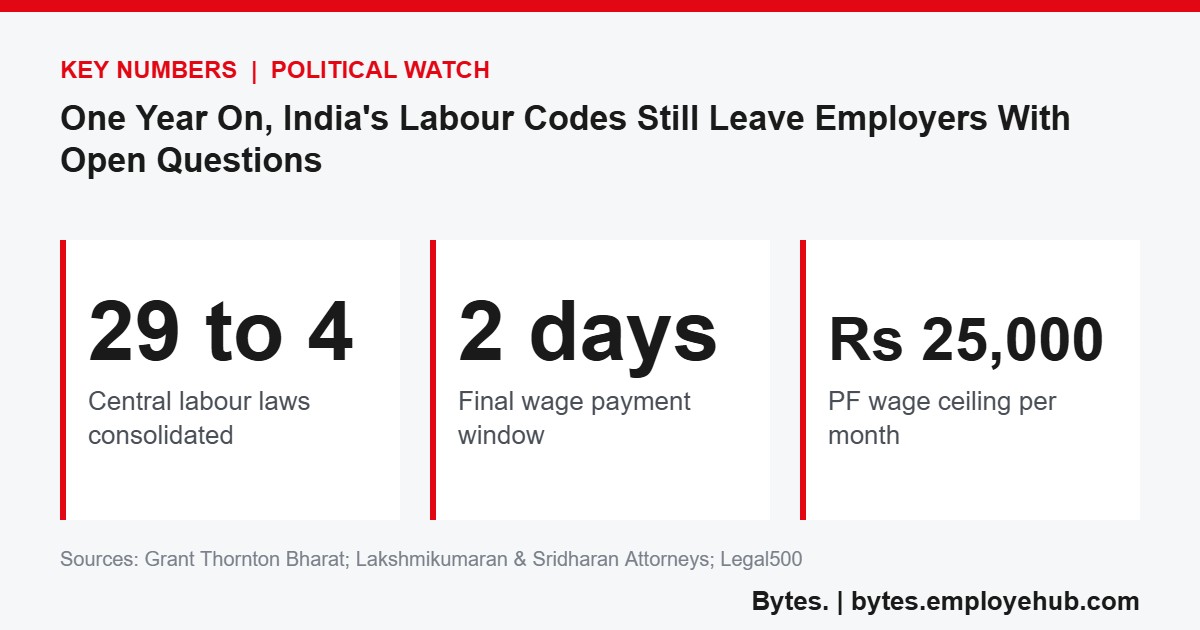
India’s four Labour Codes marked their first anniversary on 21 November 2026. The codes consolidated 29 central labour laws into four, covering wages, social security, industrial relations, and occupational safety and working conditions. A year on, employers are still working through how the rules apply in practice.
Where Implementation Stands
The central rules were notified in May 2026, including the Code on Wages (Central) Rules on 8 May. States and union territories are adopting their own rules at different speeds, so employers with offices in several states need to check requirements location by location. Law firms such as Lakshmikumaran & Sridharan held sessions this month on key developments and the way forward, including model standing orders and decisions by labour and judicial authorities.
Compliance Areas Employers Are Focused On
- Wages: the statutory wage definition drives provident fund, gratuity and bonus calculations, and excluded components are added back if they exceed 50% of total pay.
- Fixed-term employees: they receive pay and benefits equal to comparable permanent staff and qualify for gratuity after one year.
- Final pay: wages for specified exits must be paid within two working days.
- Contract labour: core business activities face restrictions, subject to exceptions.
- Provident fund: Grant Thornton notes the PF wage ceiling rose to Rs 25,000 per month in September 2026.
- Women in night shifts: employers are reviewing safeguards for work before 6 am or after 7 pm.
Questions Still Open
- Whether the two-day final pay rule covers only statutory wages or the full final settlement.
- How certain employee benefits should be valued for the wage definition.
- How registration, contributions and benefits will work for gig and platform workers, and how central and state frameworks will interact.
- How state-level rules and contract-labour exceptions will vary in practice.
Different Views
Supporters say the codes simplify compliance and extend social security to gig and contract workers. Practitioners point to uncertainty over state rules and the unresolved questions listed above. Both views are visible in how employers are responding.
For HR and payroll teams, the practical step is to map each location’s rules, align attendance and payroll records, and document decisions on classification and contract labour.
Sources: Grant Thornton Bharat; Lakshmikumaran & Sridharan Attorneys; Legal500


